Meritocracy’s Class Aspirations

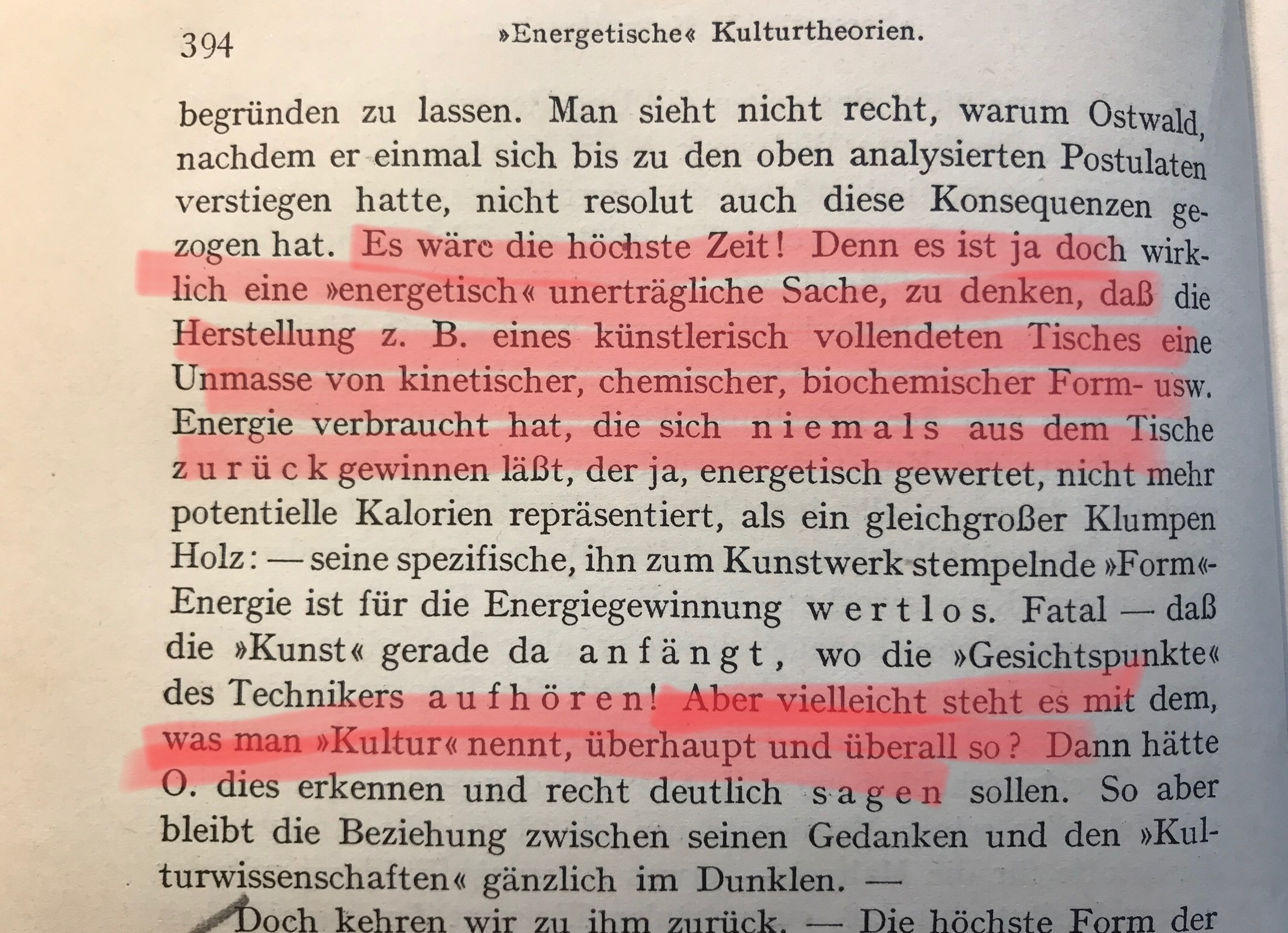
In The Academic Revolution (1968), Christopher Jencks and David Riesman describe what they call “the university college” as both the instrument of meritocratic sorting and the guardian of meritocratic values. This institution grants the “diplomatic passports” (BAs) that enable students to cross boundaries of race, religion, sex, and economic difference on their way to their socially ordained destinations: the upper-middle classes, where such prejudices and particulars are finally left behind and the management of capital can proceed most efficiently.

Two paragraphs that bring it all together:

Google’s Systems of Enticement

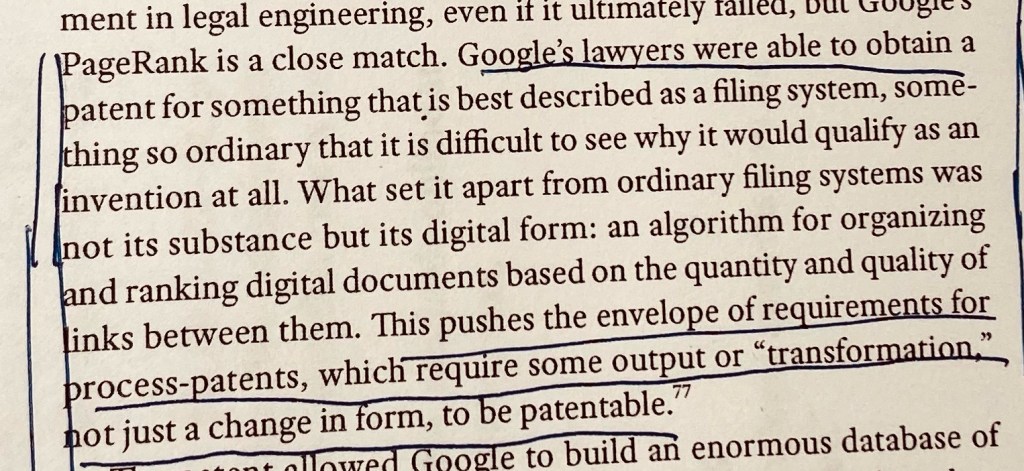
Between its initial incorporation on September 4, 1998 and January 1, 2001, Google Inc. applied for 20 patents, and over the next four years for another 428. From 2005 to 2008, the number of patent applications filed by Google more than doubled, reaching 1,044 by the beginning of 2008. There’s a story to tell about why Google decided enter the patent game and how its desire “to organize the world’s information” became a legal project to defend its data empire and fend off threats to its unmatched Index. In The Code of Capital, Katharina Pistor outlines one element of this story

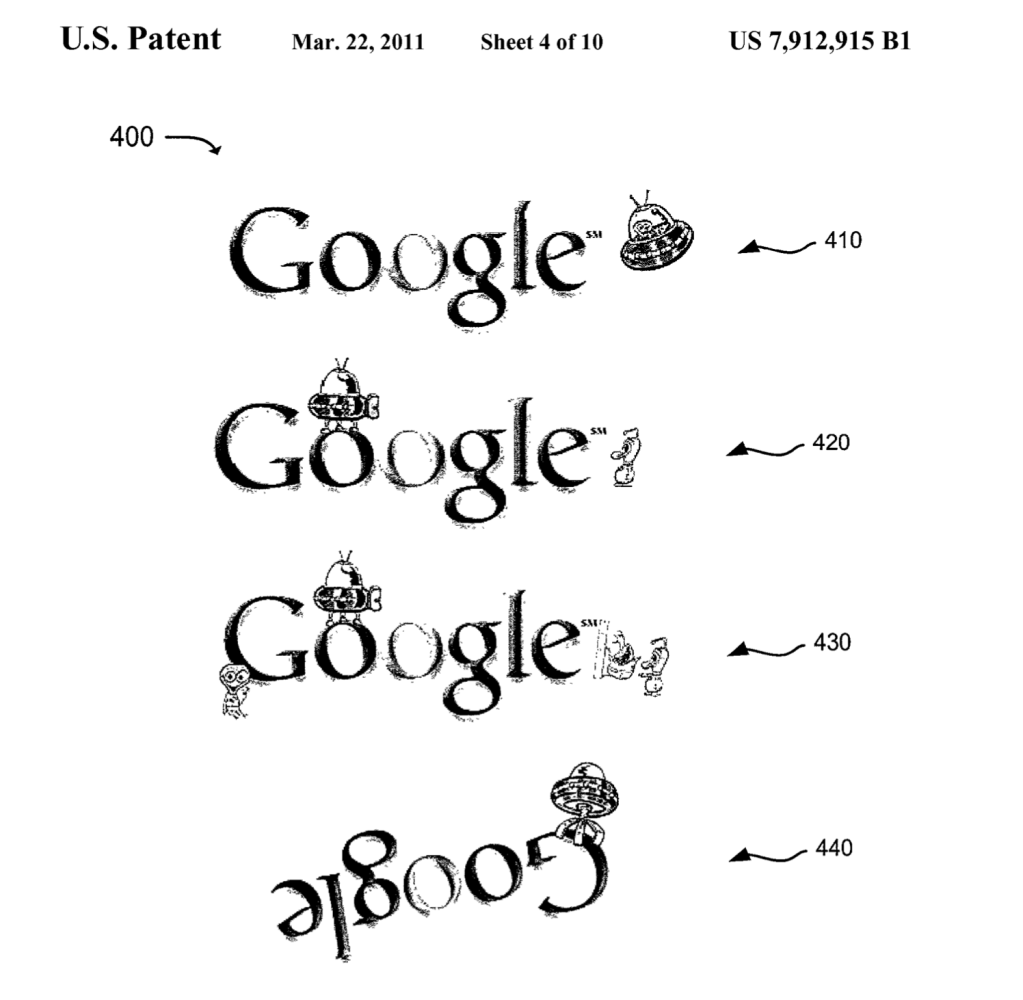
As I read through the the first several years of this material, one patent, in particular, crystalized those early years for me: No. 7,912,915 B1. On April 30, 2001, Sergey Brin filed to patent “Systems and Methods for Enticing Users to Access a Web Site”:

The present invention relates generally to client-server networks and, more particularly, to systems and methods that provide mechanisms for attracting users to a site on a network. Today, many operators of websites on the Internet use animated images, such as animated Graphic Interchange images (GIF), in webpages to make the web pages more dynamic and visually appealing to users.  The philosophy is that if the webpages are visually appealing, then they users will visit the site often. 

Brin patented the Google doodle, and called it a “system and method” for enticing users to return to a web page.

The Organized Intellect and Moral Reasoning

In 1963, Clark Kerr, then president of the University of California and “master planner” of American higher education, delivered the Godkin Lectures at Harvard University. Although those lectures are most widely known for his matter-of-fact description of the “multiversity,” the third lecture, “The Future of the City of Intellect,” concludes thus:

The organized intellect is a great machine that has gained extraordinary momentum since the Greeks got it going in 2500. It turns out countless pieces of new knowledge but with little thought for their consequences–their impact on the environment–like insecticide. Its attention to problems quite naturally does not always relate primarily to their importance, but often, instead, to the possibility of their solution. Thus the problems of rising population and rising levels of destructive capacity move along without study commensurate with their inherent significance. Does this machine have within it the seeds of its own destruction? Or can it develop an over-all rationality?. […] The process cannot be stopped. The results cannot be foreseen. It remains to adapt.

Kerr, The Uses of the University (2001, 92-93)

Kerr often spoke in these terms, embracing, on the one hand, unprecedented advances across a broad range of fields, while, on the other, pausing to point out the possible consequences of the pace and unreflective manner of postwar scientific and technological progress. But his pauses were always brief and largely of no substance. In his position as UC president and then chair of the Carnegie Commission on Higher Education, Kerr did many things, but generally overlooked is his perfection in both practice and theory of what I’d call a Cold War liberal ethics. He legitimated and helped to institutionalize the ideal of post facto moral reasoning.

The ideal of post facto moral reasoning continues to shape how most universities, not to mention most tech companies, conceive of the “ethics” initiatives and courses they now feel compelled to implement. When scientific and technological progress is given as fact, as having already been accomplished and presumed to have value, the purpose of “ethics” is moral accommodation. Doing ethics is simply learning how to live with the new reality. Taking scientific and technological progress as that which is simply given replaces moral reasoning––giving and rebutting arguments and claims about the good, recognizing conflicting values with others and within traditions and communities––with therapeutic forms of rationalization. After scientists and technologists have changed our shared reality, social therapists are needed to console the rest of us with strategies and psychic balms. Or, as, engineering and data science programs do it: we need a historian, a humanist, or really just anyone who can claim to care about this stuff to teach a three-credit course on AI ethics or the ethics of data.

Performing Authenticity

Although we have no access to the confidential dossier, we have all worked for many years in close proximity to Professor Ronell…

Draft letter in defense of NYU German Professor Avital Ronell.

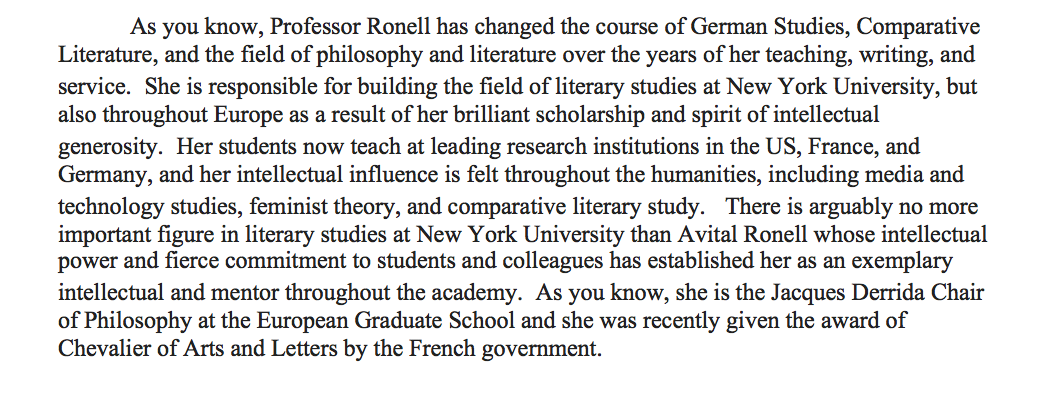
The letter’s list of signatories reads like the syllabus of my lit theory proseseminar in grad school. And this is their very public performance of moral reasoning:

Screen Shot 2018-08-14 at 8.50.08 AM

The absolute reverence for charismatic, against-the-grain smartness––a smartness that cannot be limited by clarity or force of argument, constrained by evidence, tempered by humility, sullied by philistine integrity, bothered by commitments to an other who is not an abstraction––is an ethical and intellectual sham.


Philosophia Perennis and Philosophical Therapy

Philosophy was supposed to be different from other disciplines, or so I thought some forty-five years ago, when I was hooked. Philosophers were supposed to be, like Socrates, the fearlessly critical ones. The ones who stood back and said, look, don’t uncritically buy into the values of your society. Reflect. Question. Are these values truly those of a good life? Now too many philosophers have decided to set old Socrates aside, embracing the productivity principle.

Mitchell Aboulafia, Jacobin.

Why was philosophy supposed to be any different? Why would it escape the radical transformations––or deformations––of the modern research university? Over the course of the nineteenth century, philosophy became a discipline just like history, philology, or physiology did; it became a highly specialized and institutional way of knowing. And some folks refuse to come to terms with this.

The elegy for a philosophia perennis, a wisdom that tells us how to live, courses through early modern and modern European intellectual history. From Giovanni Pico della Mirandola’s humanist syncretism and Kant’s metaphysics-to-come to Max Weber’s critics in the 1920s and Habermas’s life-world, the desire for a single, unifying source of concepts and norms never abates. It’s an eschatological dream of reason overcoming its temporal divisions and realizing an ethical totality.

One of the most salient and consistent criticisms of Weber’s “Scholarship as Vocation” (1917) was that the German sociologist had demoted philosophy to a mere Fachdisziplin––a specialized form of university-based knowledge. But he was right. German universities had turned philosophy into just another discipline; they produced philosophical knowledge by means of a division of labor just as they produced chemical or philological knowledge. These were all forms of alienated labor and, thus, the kinds of knowledge they produced had no relation to, in the ubiquitous term of the day, Leben.

And this just was, as Albert Dietrich put it in 1922, the “permanent crisis of philosophy” [Dauerkrisis der Philosophie]. Like many post-war German intellectuals, Dietrich dated that crisis to Hegel’s death, when real philosophy––as in a full-throated idealism––gave way to “mere” epistemology. Weber had provided the right diagnosis of the situation around 1917 but he had offered no possible therapy. Dietrich, like so many intellectuals in the decades to come (and even now it seems), longed for a recovery of true philosophy, what Kant called “a total unity” [eine absolute Einheit], a philosophy thought would integrate life and knowledge, the fragmented disciplines, the human. Only a philosophia perennis can save us.


Scholars are neither heroes nor prophets

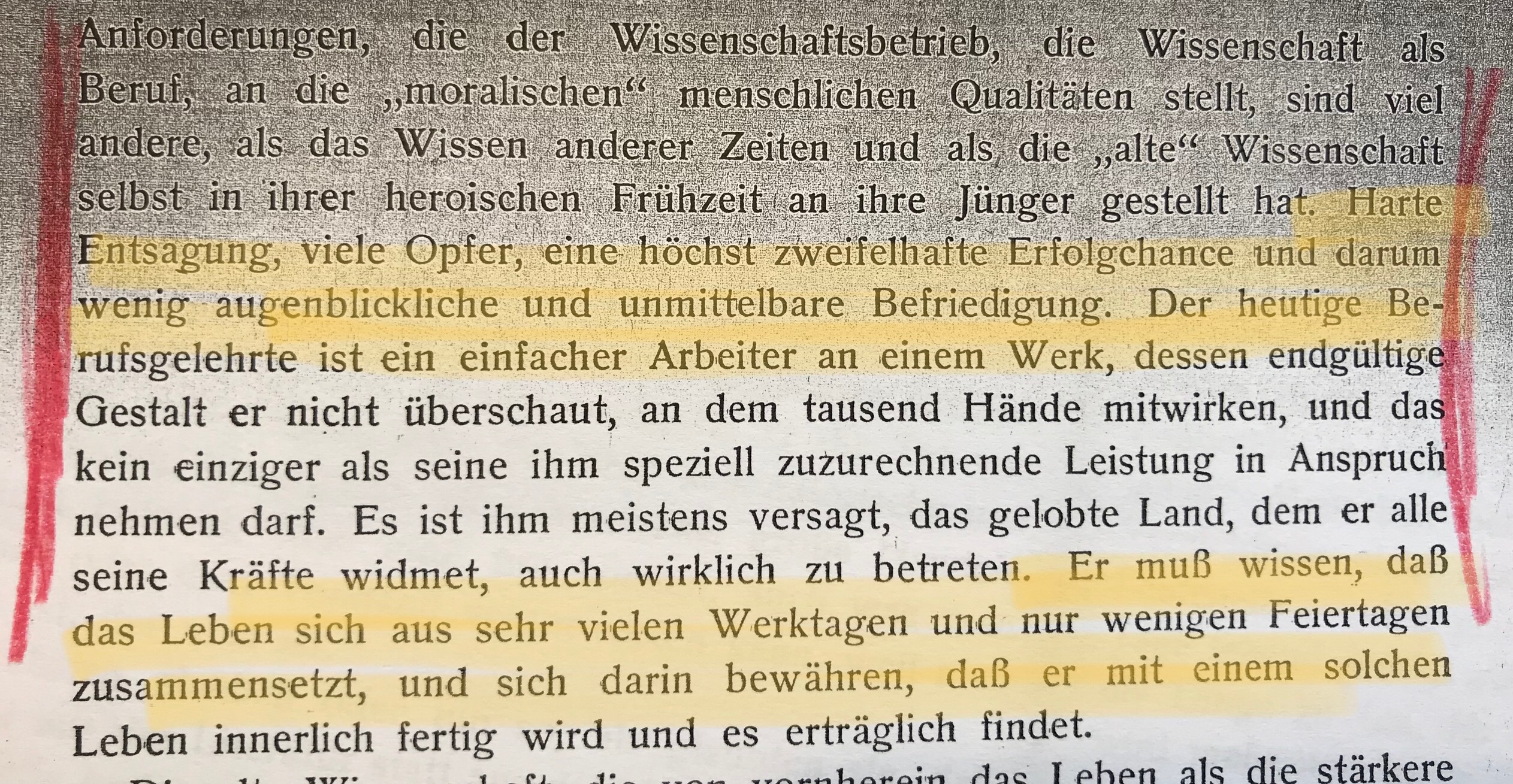
Today’s professional scholar is a simply a worker doing his work….He knows that life consists of innumerable work days and only a few holidays; he knows that in order to prove himself he’s got to come to terms with this life; he’s got to find it bearable.

Arthur Salz, Für Wissenschaft gegen die Gebildeten unter ihren Verächtern (1921).

Anytime I mistake what I do for more than it is, I reach for the Germans writing around the turn of the twentieth century. Salz, a sociologist who taught at Heidelberg until the Nazis forced him out of Germany in 1933, responds to Max Weber’s Wissenschaft als Beruf:

IMG_2305


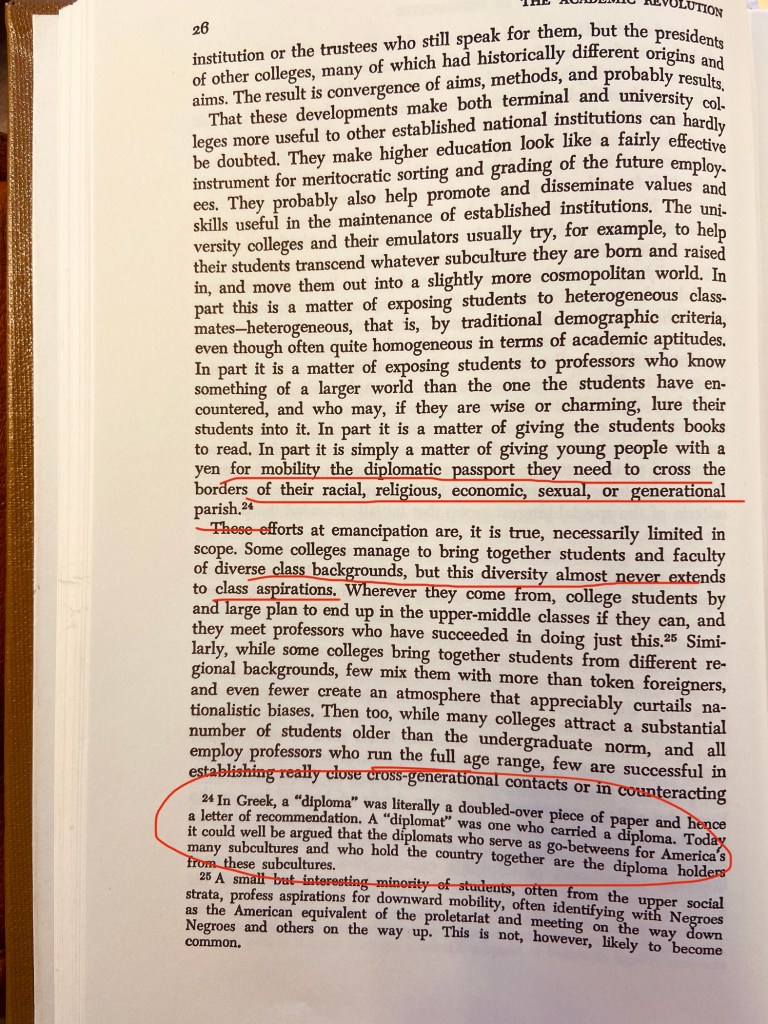
art, energy, and efficiency

IMG_2304

In 1909, the German chemist Wilhelm Ostwald published a theory of culture [Kulturwissenschaft] based on “energetics,” the idea that the flux of energy (how energy-relations changed in space and time) could explain everything in the natural world. Max Weber reviewed Ostwald’s Energetische Grundlagen der Kulturwissenschaft that same year. And he didn’t like it. (His underlying critique amounted to “One discipline to rule them all!” turns one way of knowing into a comprehensive worldview). It’s a crucial text for a number of reasons, one being it moves my final chapter along.

But Weber’s brief aside (above) on how Ostwald’s theory might account for art is just perfect. According to the “purportedly precise” formulas of an “energetics cultural theory,” writes Weber, the value of anything––a person, a new technology, a society––can be determined by calculating the amount of energy it saves. The printing press was of great cultural value, for example, because it reduced the amount of energy required to distribute information.

But what about a fine, well-crafted table, asks Weber? Wouldn’t it be an unconscionable waste of resources, time, and, ultimately, energy to spend months finding the right wood, preparing the lumber, designing plans, cutting and fitting the pieces together, and then coating it with a finish? Such a thing would be but a memorial to wasted calories.

Art just isn’t efficient.


academic reading

I knew academic writing was different than trade writing, but I was unprepared for the way reading—and consequently writing—was treated in the context of academia.

Douglas Hunter, “Book Breaking and Book Mending.”

Most essays lamenting the ways graduate school deforms minds and bodies focus on bad academic writing. Hunter considers how it habituates the ways we read. Academic reading fuels production not pleasure or transformation. I certainly find the training difficult to undo. I read for nuggets, arguments, metaphors, evidence, sources––Bestand to repurpose for my own thinking and writing. I can defend such a readerly disposition. But I long for the ability to toggle from this academic way of reading to others . . .and then back.

pick up and read

Pick up and read, pick up and read…I neither wished nor needed to read further. At once, with the last words of this sentence, it was as if a light of relief from all anxiety flooded into my heart. All the shadows of doubt were dispelled.

Saint Augustine, The Confessions.

But Saint Augustine did keep reading. He also kept preaching and writing. He was always in via and what he read and the notes he left mark that path. Here’s how my friend Matt Puffer puts it in his dissertation:

The North African Manichee hearer-turned-Catholic, reluctant but conscientious priest, and always- progressing bishop seems one who never arrived, at least not in his own estimation, but is always in via. Even as a seasoned bishop, he confesses to his congregation, “I am still following, still developing, still walking, still in via, still stretching out, I have not yet arrived,” [adhuc sequor adhuc proficio adhuc ambulo adhuc in uia sum adhuc me extendo nondum perueni] and thus exhorts them likewise, “Be always giving, always walking, always developing” [semper adde semper ambula semper profice].

Believing the peace that he desired was reserved for the elect, those who would see God face to face in the next life, Augustine desired little more out of this life than to make progress in faith and wisdom, in loving God and God’s image within the rational soul. And, he experienced this progress nowhere more so than through his preaching and writing. In a sermon we read, “We develop as we write, learning every day, preaching as we explore [proficiendo scribimus cottidie discimus scrutando dictamus].” Likewise, his letters record his experience: “Developing I write, and writing I develop” [proficiendo scribunt et scribendo proficiunt].

I started this blog in hopes of keeping better track of my own bibliographic biography. Twitter and Facebook had become default organizers of my online reading and thinking. There are, as some smart people have discussed, a host of problems with that. But my most immediate frustration was how poorly they organized my reading ways, so I’m going old-school with a blog.