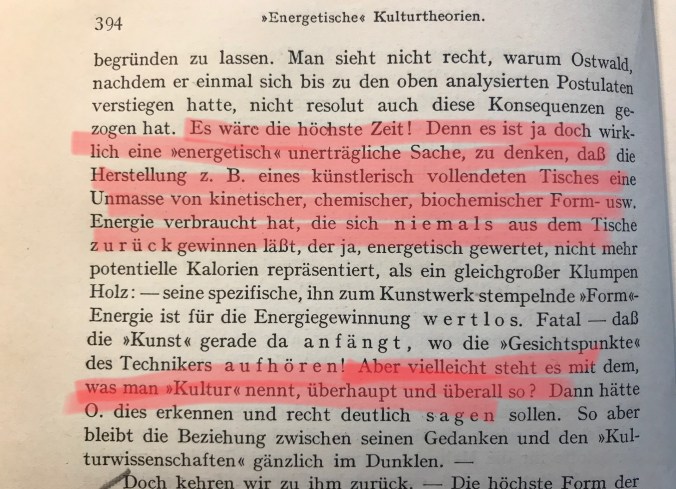
In 1909, the German chemist Wilhelm Ostwald published a theory of culture [Kulturwissenschaft] based on “energetics,” the idea that the flux of energy (how energy-relations changed in space and time) could explain everything in the natural world. Max Weber reviewed Ostwald’s Energetische Grundlagen der Kulturwissenschaft that same year. And he didn’t like it. (His underlying critique amounted to “One discipline to rule them all!” turns one way of knowing into a comprehensive worldview). It’s a crucial text for a number of reasons, one being it moves my final chapter along.
But Weber’s brief aside (above) on how Ostwald’s theory might account for art is just perfect. According to the “purportedly precise” formulas of an “energetics cultural theory,” writes Weber, the value of anything––a person, a new technology, a society––can be determined by calculating the amount of energy it saves. The printing press was of great cultural value, for example, because it reduced the amount of energy required to distribute information.
But what about a fine, well-crafted table, asks Weber? Wouldn’t it be an unconscionable waste of resources, time, and, ultimately, energy to spend months finding the right wood, preparing the lumber, designing plans, cutting and fitting the pieces together, and then coating it with a finish? Such a thing would be but a memorial to wasted calories.
Art just isn’t efficient.
 tolle lege